


Common Poshmark Scams and How to Stay Safe as a Buyer or Seller
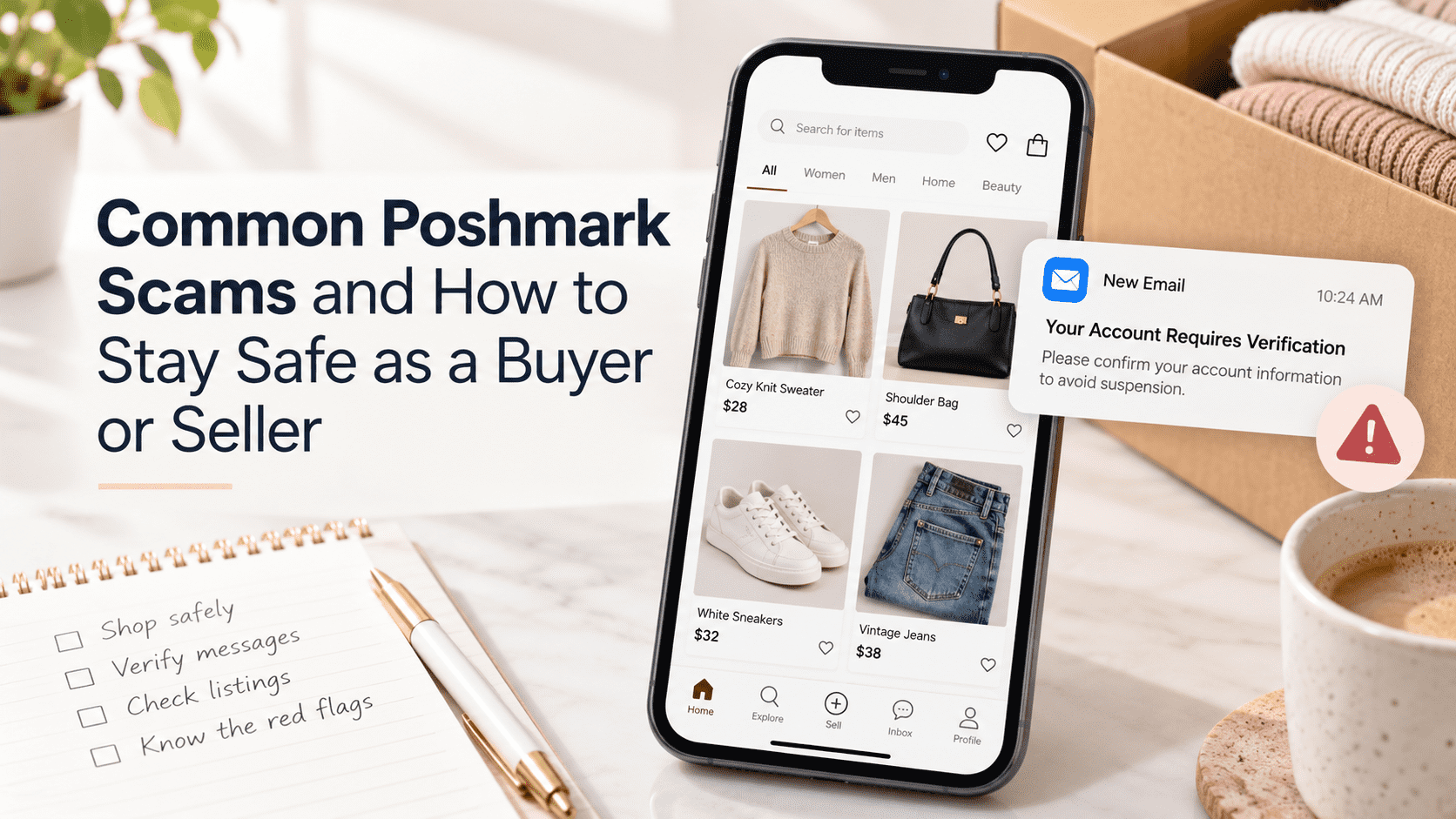
You list an item on Poshmark, and not long after, someone asks you to email them more photos. Or you get an email saying your item has sold, even though there is no sale showing in your Poshmark account.
If you’re new to the platform, these messages can look convincing. And that’s exactly what scammers count on.
Poshmark itself is a legitimate marketplace, but scammers may target both buyers and sellers through fake emails, phishing links, suspicious payment requests, and other tricks. Many of these scams have one thing in common: they try to move you away from Poshmark’s normal buying or selling process.
So, how can you tell what’s real?
In this guide, we’ll cover the most common Poshmark scams and explain why some sellers get scam emails soon after listing an item. We’ll also explain what to do if you’ve already clicked a suspicious link or sent someone information you shouldn’t have.
Is Poshmark Safe and Legit?
Yes. Poshmark is a legitimate resale marketplace, and it has protections in place for transactions completed through the platform.
Under Posh Protect, buyers can report eligible problems such as an item not arriving, undisclosed damage, or receiving something that does not match the listing. Buyers generally have 72 hours after delivery to open a case.
The important part, though, is staying within Poshmark’s normal transaction process. If a buyer or seller moves the transaction off the platform, Posh Protect does not cover it.
So, if someone asks you to pay elsewhere, continue the conversation by email, or click an unfamiliar payment link, treat it as a warning sign.
If you want to know more about Poshmark itself and how its buyer and seller protections work, check out our guide on whether Poshmark is legit and safe to use.
Common Poshmark Scams to Watch Out For
Poshmark scams don’t all look the same. Some are obvious, while others start with a request that seems completely harmless. What matters is recognizing when a normal conversation starts moving in an unusual direction.
Here are some common scams both buyers and sellers should know about.
1. Requests to Take the Conversation Off Poshmark
Some Poshmark scams begin with a simple request for clearer photos.
A potential buyer may say that your listing photos look blurry or won’t load properly, then ask you to email or text them better versions. New sellers have reported receiving exactly this type of message, sometimes within minutes of publishing a listing.
Asking for more photos is not suspicious by itself. The red flag is the request to move the conversation away from Poshmark.
Once that happens, the scammer may follow up with a fake sale confirmation, phishing link, or payment request. In one reported case, a new seller sent additional photos by email and later received a fake payment message directing them to enter card information.
Poshmark’s Community Guidelines also tell users not to move transaction-related communication to email, phone, or other off-platform channels.
If a buyer genuinely needs more information about an item, the conversation can stay on Poshmark.
2. Fake “Your Item Sold” Emails
For a new seller, making the first sale is exciting. Scammers know that.
A fake email may appear shortly after you publish a listing and claim that someone has already bought your item. It may include the product name, photos, or other details from your real listing, making the message look much more convincing.
Then comes the important part: a button or link asking you to “confirm the sale,” “receive funds,” or enter payment information.
This is not just a theoretical scam. In August 2026, a first-time Poshmark seller reported receiving an email saying that payment had been made. After clicking “confirm sale,” the seller was taken to a page asking for credit card information. A fake customer-service chat then claimed the card needed at least $300 available before the payment could be processed.
That gives you one of the simplest ways to check a suspicious sale: don’t let the email be your only source of information.
Open Poshmark directly and check whether the sale actually appears in your account. If you are new to the platform, our guide on how to sell on Poshmark walks through the process from listing to shipping and getting paid.
3. Fake Poshmark Support or Account Verification
Sometimes the scammer doesn’t pretend to be a buyer at all. They pretend to be Poshmark.
You may be told that your seller account needs verification, a payment is being held, or there is a problem preventing you from receiving your money. The message then directs you to a page or “support agent” that asks for card details, login information, or money.
Impersonation scams like this extend far beyond Poshmark. According to the Federal Trade Commission (FTC), consumers reported losing $3.5 billion to imposter scams in 2025. Nearly one in three fraud reports that year involved an imposter scam.
A familiar logo, professional-looking page, or “support” chat therefore isn’t proof that you are dealing with the real company.
Pay more attention to what the message is asking you to do. Be cautious if a message suddenly asks for financial information or money. Instead of following the link, verify the request directly through Poshmark.
4. Counterfeit or Misrepresented Items
Buyers face a different kind of risk: receiving an item that is fake or very different from what was advertised.
This is especially relevant when shopping for designer bags, shoes, clothing, or other branded products. A listing may use convincing photos, packaging, or descriptions while the actual item turns out to be a replica.
There are real examples of buyers reporting this experience. In 2025, one buyer described purchasing a Coach Brooklyn bag on Poshmark at a lower-than-usual price. After receiving it, the buyer noticed several problems, including poor materials, incorrect details, and stitching that did not match the genuine product. The seller had also listed several identical bags using the same photos.
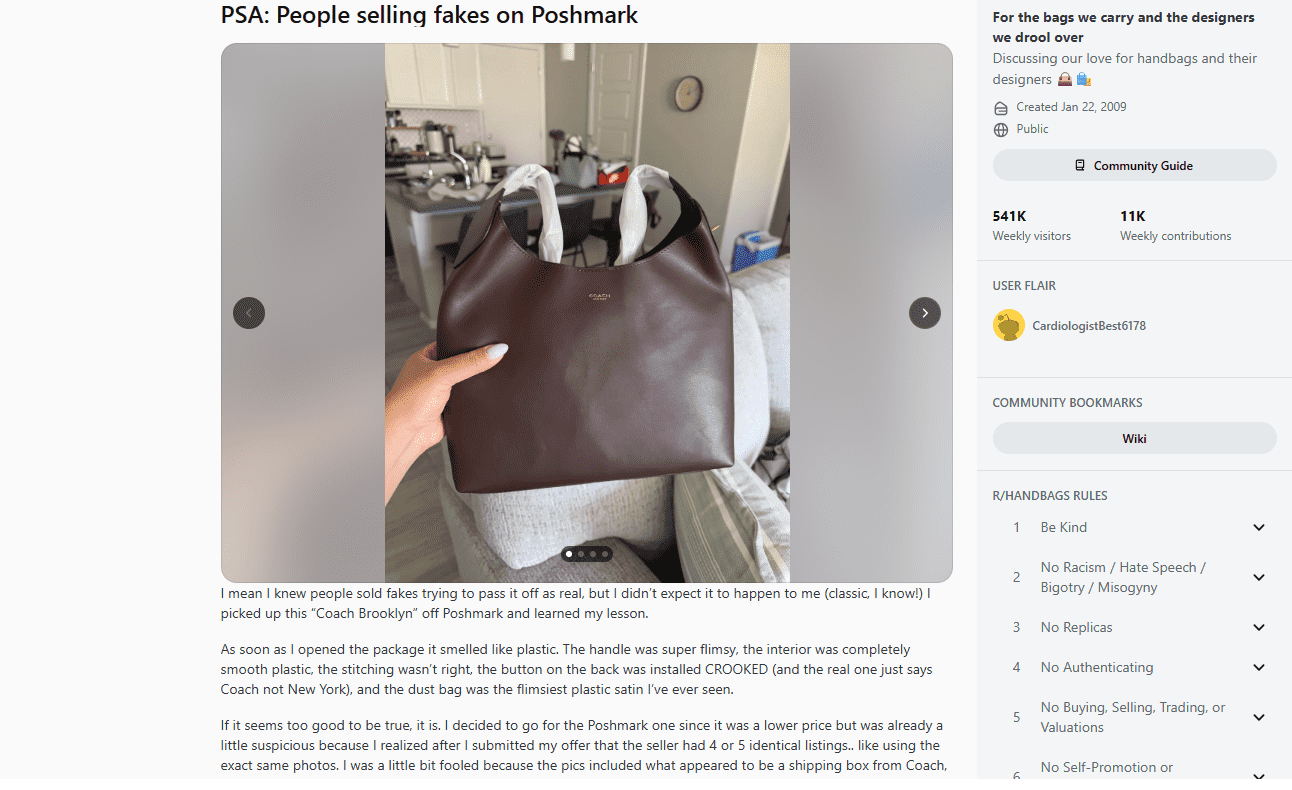
A low price alone does not prove an item is fake. But low prices, duplicate listings, unclear sourcing, or inconsistent details should make you look closer.
Poshmark prohibits counterfeit goods, and items that are not authentic may be covered under Posh Protect. The platform also offers Autenticación elegante for eligible luxury items. Currently, select luxury products priced at $500 or more may qualify, and qualifying listings display an “Authentication Included” badge.
That does not mean every item over $500 is automatically authenticated. Eligibility depends on the brand and category, so buyers should check the listing rather than assume authentication is included.
For sellers who regularly resell branded products, knowing where the inventory comes from matters too. You can also learn more about becoming an authorized online retailer.
5. Off-Platform Payment Scams
A buyer or seller may suggest skipping Poshmark’s checkout and paying another way instead. They might offer a better price if you use PayPal, Venmo, Zelle, or another pago método directly.
The payment service itself is not the problem. The warning sign is that a transaction that started on Poshmark is being moved somewhere else.
Poshmark’s Terms of Service require buyers to use approved payment methods. A transaction that starts on Poshmark may not be completed off the platform.
So, an offer to “save on fees” or give you a special discount for paying elsewhere is not just an alternative way to check out. It moves the transaction outside Poshmark’s normal payment process. If the other person disappears or the deal goes wrong, getting help can become much harder.
Be especially cautious when the offer sounds unusually attractive. Saving a few dollars is rarely worth taking a transaction into a less protected environment.
6. Return and Item-Swap Scams
Sellers sometimes worry about a different problem: sending out the correct item and receiving something different back after a return is approved.
For example, a buyer may claim that an item arrived damaged or was not as described, then return an older, damaged, or different version of the product.
These cases are harder to measure because most of the evidence comes from individual seller reports rather than platform-wide data. Still, sellers continue to describe this type of experience.
In September 2026, one Poshmark seller reported selling a lightly used faux-leather jacket. After delivery, the buyer opened a “not as described” claim using photos that showed tears around the collar. The seller said those tears were not visible in the original listing photos and believed a different, older jacket was being returned.
That does not mean every disputed return is fraudulent. Buyers can have valid reasons to open a case. These include undisclosed damage or an item that does not match the listing.
The concern for sellers is whether the item coming back is actually the same one they shipped. Clear listing photos and records of an item’s condition can become important if a dispute occurs.
Why Am I Getting Poshmark Scam Emails?
If scam emails start arriving soon after you list something on Poshmark, it is easy to wonder whether the platform gave someone your email address. That is not necessarily what happened.
One explanation that comes up repeatedly in community discussions is simple: your Poshmark username may match the first part of your email address.
For example, if your Poshmark username is miafashion, a scammer can try common addresses such as miafashion@gmail.com o miafashion@yahoo.com.
In 2026, one seller reported getting more than 20 emails about a newly listed dress. Other users noticed that the seller’s Poshmark username matched the beginning of the email address.
That does not explain every case. Some people reuse the same username across marketplaces, social media accounts, or other public profiles, which can make an email address easier to guess or trace. In other cases, it may not be obvious how the sender found the address at all.
It is also worth separating current scam emails from an older security issue. In 2019, Poshmark disclosed that an unauthorized third party had acquired some user data, including email addresses and other account information. However, there is no evidence that a scam email you receive today necessarily came from that incident.
A suspicious email after you create a listing does not automatically mean your account was hacked. It also does not prove that Poshmark shared your email with the sender.
If your Poshmark username closely matches your email address, changing one of them may make that simple guessing method harder. More importantly, verify messages about listings, sales, and payments inside Poshmark instead of relying on an unexpected email.
How to Avoid Poshmark Scams
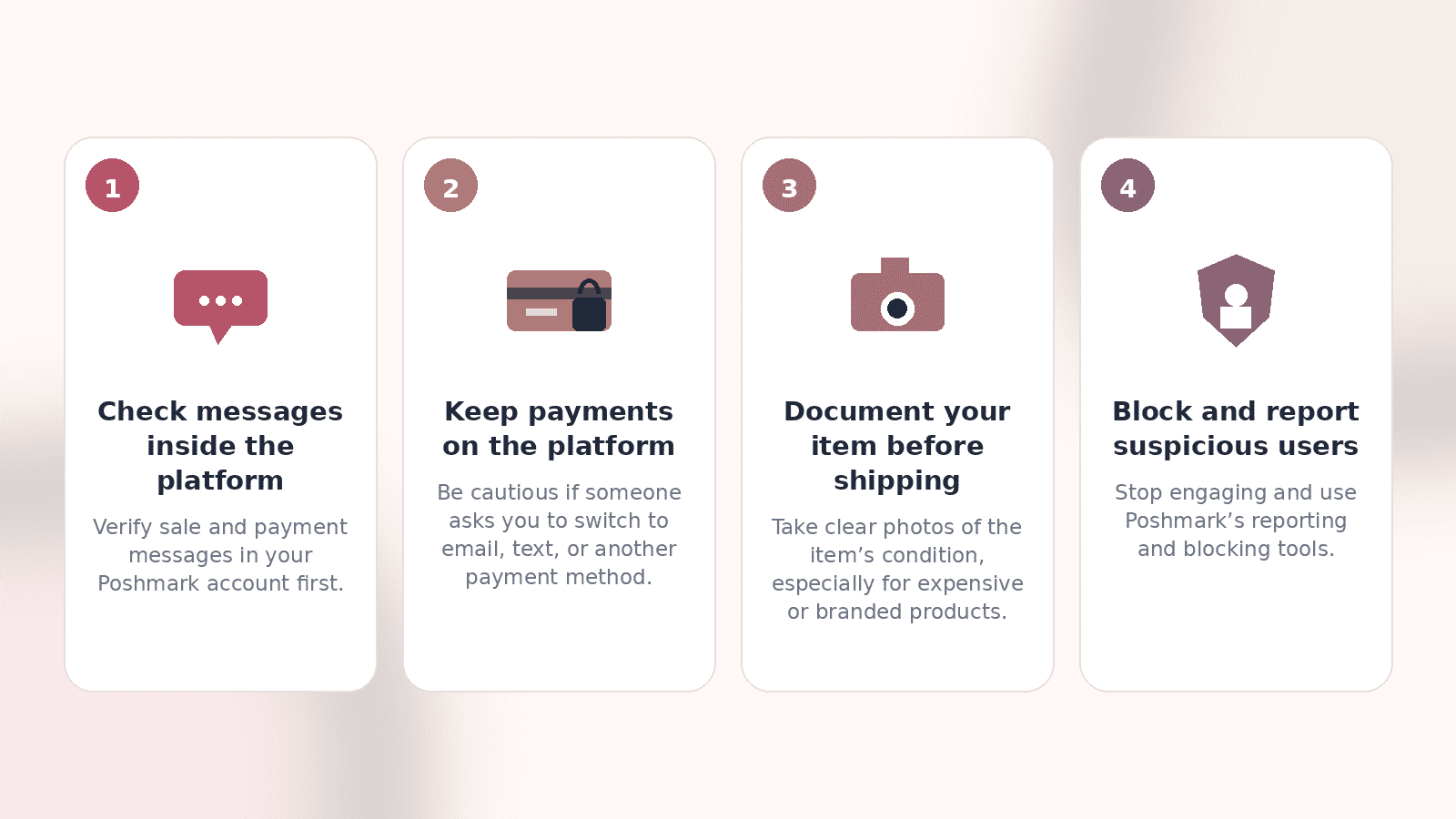
You do not need to memorize every scam to stay safe on Poshmark. Most problems become easier to spot when you know what a normal transaction should look like and pause when something breaks that pattern.
Check Important Messages Inside Poshmark
Treat your Poshmark account as the main source of truth. If an email says you made a sale or your payment is on hold, open Poshmark directly. Do not rely on the link in the message.
A real sale, order update, or account issue should have a corresponding record inside the platform. If the email and your account tell you two different things, do not rush to follow the email.
Keep Payments and Conversations on the Platform
If someone asks you to continue the transaction through email, text, or another payment service, be cautious.
The issue is not that every outside payment app or private message is dangerous. It is that moving away from Poshmark makes it harder to verify what is happening and may take the transaction outside the platform’s normal protections.
Document Your Item and Follow the Official Shipping Process
For sellers, good records can help if a dispute comes up later. Take clear photos showing the item’s actual condition before Envío, especially for expensive or branded products. Poshmark also recommends photographing details such as serial or date codes for luxury items and including relevant documentation when available.
After a genuine sale, follow the shipping instructions shown in your Poshmark account. Poshmark provides the shipping label or QR code needed for the order. Be cautious if someone sends you a different label or asks you to ship to another address. The same applies if their instructions do not match the order page.
Block and Report Suspicious Users
You do not have to keep replying to someone just to find out whether they are a scammer.
Poshmark’s User Safety Tips recommend not engaging with unwanted communication. The platform also allows users to block or report suspicious accounts, listings, comments, and conversations.
A little skepticism is useful, but the goal is not to assume every buyer or seller is dishonest. Slow down when a request takes you outside the normal Poshmark process, and verify what is happening before you act.
What to Do If You Get Scammed on Poshmark
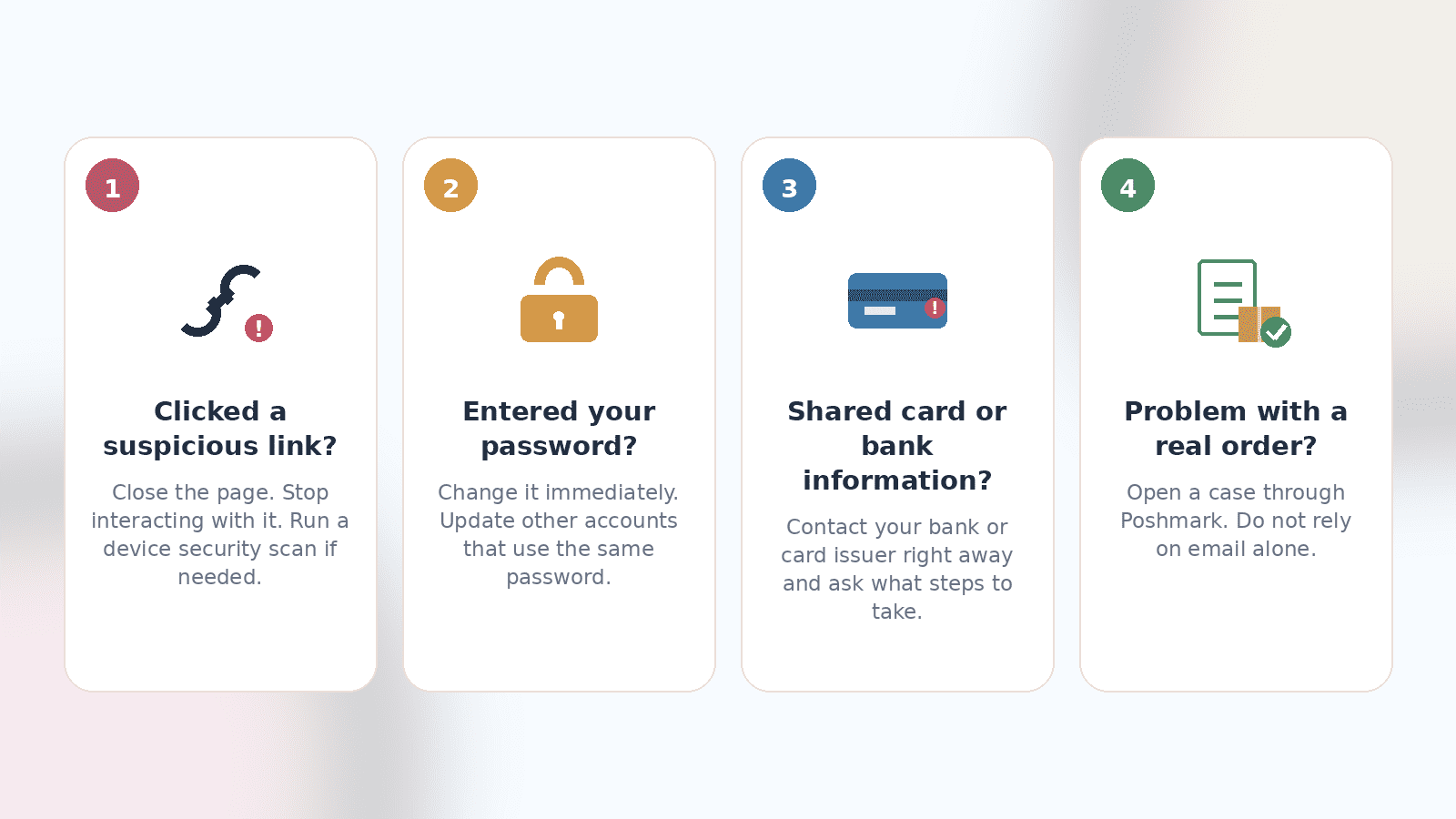
What you should do next depends on how far the scam went. Receiving a suspicious message is very different from entering your password, sharing card information, or having a problem with an actual Poshmark order.
If You Clicked a Suspicious Link
If you clicked a link but did not enter any information, close the page and avoid interacting with it further.
The Federal Trade Commission also recommends updating your security software and running a scan if you think the link may have downloaded something onto your device.
If you entered your Poshmark password, change it as soon as possible. And if you reuse the same password for your email, shopping accounts, or other websites, change those passwords too. Turning on two-factor authentication where available can add another layer of protection.
If You Shared Card or Bank Information
If you entered card or bank details on a fake Poshmark page, contact your bank or card issuer immediately.
Explain what happened and ask what steps they recommend, such as blocking the card, replacing it, or disputing an unauthorized payment. The FTC advises contacting your bank or card issuer as soon as possible. Ask whether the payment can be reversed.
Do not keep communicating with someone claiming they need another card, an additional payment, or more money in your account before they can release your funds. Those requests can simply extend the original scam.
If the Problem Involves a Real Poshmark Order
If an item never arrives, is damaged, does not match the listing, or appears counterfeit, handle the problem through the Poshmark order.
Under Posh Protect, buyers generally have 72 hours after delivery to open a return case and provide supporting photos. Do not accept the order first if there is a problem, because accepting it can prevent you from opening a return case afterward.
One detail is easy to miss: emailing Poshmark Support does not count as opening a return case. The case needs to be opened through the order in the Poshmark app or website.
If the issue involves phishing or a suspicious account, report the user or message through Poshmark. You can also report the fraud to the FTC.
FAQs About Poshmark Scams
1. Is Poshmark a scam?
No. Poshmark is a legitimate resale marketplace. However, scammers can still use the platform to target buyers and sellers. Staying within Poshmark’s normal payment, messaging, and shipping process can reduce the risk.
2. How do I know if a Poshmark buyer is scamming me?
Be cautious if a buyer asks you to move to email or text, pay outside Poshmark, click an unfamiliar link, or provide card details to receive money. Another warning sign is a “sale” that does not appear in your Poshmark account.
3. Does Poshmark refund you if you get scammed?
It depends on what happened. Under Posh Protect, eligible problems such as an item not arriving, being counterfeit, or not matching the listing can qualify for a refund. Buyers generally have 72 hours after delivery to open a case. Transactions completed outside Poshmark are not covered.
Pensamientos finales
Most Poshmark scams become easier to spot once you know how a normal transaction works. A sale should appear in your account. Payments and shipping should follow Poshmark’s process. And you should never need to send money just to receive money.
If something feels off, slow down and check it inside Poshmark first. A few extra seconds can save you from clicking a fake link or sharing information with the wrong person.
If you want to go beyond clearing out your closet and start a reselling business, sourcing reliable inventory is another challenge. Our guide to product sourcing methods can help you understand where and how to find products.
Sup Dropshipping can also help with sourcing products from China and checking their quality before you purchase inventory. Just keep Poshmark’s rules in mind: sellers must have possession of and ship the actual item described in the listing.
Sobre el Autor

Puede
May es bloguera de Sup Dropshipping con más de 5 años de experiencia en comercio electrónico. La pasión de May por el comercio electrónico la impulsa a mantenerse actualizada sobre las últimas tendencias y compartir su experiencia con usted a través de su blog. En su tiempo libre le gusta leer una novela o charlar con amigos.

Deja una respuesta